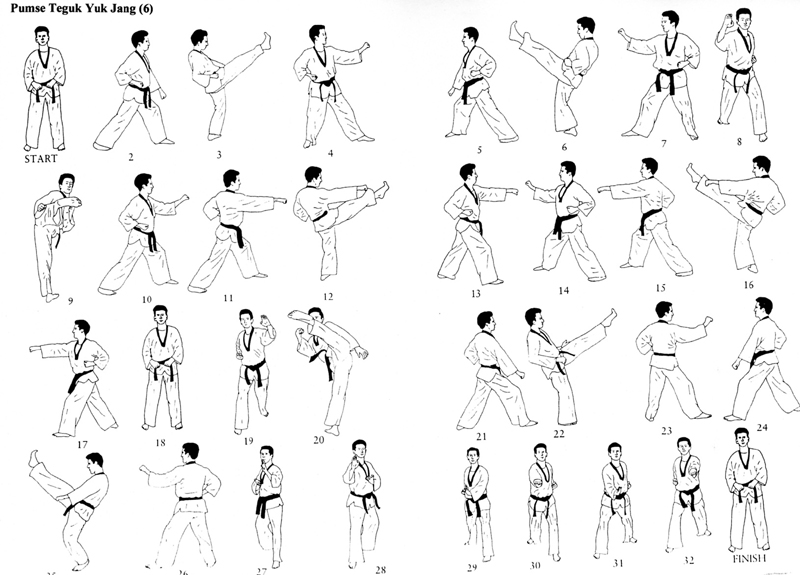
Explaining Poomse (or Forms) to students
Tuesday, October 9th, 2007Poomse (or forms) is probably one of the traditional training techniques I’ve seen that doesn’t seem to easily lend itself to learning real self-defense. Why you ask?
In a confrontation there is chaos, however when one looks at someone doing a form, everything seem very orderly. So how does a form apply towards learning self-defense?
This is how I justify forms:
- The stances and hand positioning in a form do not necessarily correspond to how you will position yourself in a real situation.
- Forms are good for learning coordination, balance, timing, stamina, and strength.
- The self-defense techniques used in forms are actually pretty awesome and deadly. Students need to apply them in a less structured way so as to make it more natural and one with the chaotic nature of a fight.
- When doing a form, make sure each set of movements has meaning, by understanding exactly what the attack is, and what the defensive and counter-attacks it corresponds to; on top of that the attacks are aimed at certain vital points.
Thus if one is able to separate the above concepts from the way forms are done in class (or competition), one can justify the use of forms in training.